

When opera leaves the theater: Mozart, the Met and classical music in the age of new technology
What do the Mozart Interactive Museum in Prague and the Metropolitan Opera in New York have in common? Both show that today we don’t always have to travel back in time to experience classical music. Sometimes technology is all it takes.
Imagine you are sitting in a cinema and the curtain of the Metropolitan Opera in New York is rising in front of you. On stage, the singers are performing for thousands of people. Yet you see them up close – much closer than you ever could from an ordinary seat in the auditorium. And when the intermission comes, the camera takes you straight backstage. You watch interviews with the artists, the preparations for the performance and an atmosphere you would otherwise never experience.
This very year marks 20 years since the Metropolitan Opera began broadcasting its performances to cinemas around the world.
And it is not just a story about technology. It is also a story about how the way we experience classical music is changing – and how new technologies can bring art closer to people who might otherwise never encounter it.
From the opera house to the cinema
When opera broadcasts first appeared twenty years ago, they were something completely new for many viewers. For one evening, the cinema turned into an opera house. Some people came in evening dress, applauded after the arias and rose to a standing ovation after the final note.
Today things are different. You can come to an opera broadcast in jeans and grab some popcorn before the show, and still experience something far removed from an ordinary night at the movies.
Technology doesn’t have to take the life out of a performance. On the contrary, in its own way it can bring that life to you. The camera takes you right up to the artists and shows you their faces, their gestures and what goes on backstage. During the intermission, the viewer becomes almost a visitor who is allowed to take a peek behind the curtain.
The same idea guides the Mozart Interactive Museum in Prague: to use today’s technology not to replace live art, but to open up a new path to it.
Stars up close
Over twenty years, the broadcasts from the Metropolitan Opera have become a phenomenon and have introduced millions of viewers to the world’s great singers. The names associated with them include Renée Fleming and Jonas Kaufmann. And also the Czech bass-baritone Adam Plachetka, who has sung Leporello in Don Giovanni many times on the stage of the Metropolitan Opera.
The Mozart Interactive Museum also has a personal connection with Adam Plachetka: he performed at the grand opening of our museum on December 12, 2024.
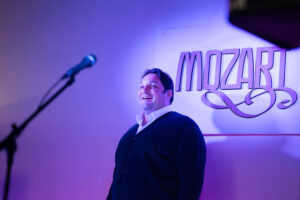
The difference in scale could hardly have been greater. At the museum, he sang in an intimate setting, accompanied by a piano, for around a hundred listeners. At the Metropolitan Opera, he performs in front of almost four thousand people, and through the broadcasts his performance reaches audiences all over the world.
But something else is even more interesting: for the singer himself, the size of the venue changes nothing essential.
In an interview with Czech Radio, Adam Plachetka said that whether he sings for a hundred people or for several thousand, he always gives it everything.
And this is exactly where the two worlds – the great opera and the small interactive museum – surprisingly meet.
Technology as a bridge, not a replacement
Of course, an interactive museum cannot replace a living Mozart, just as a cinema cannot fully replace an evening at the Metropolitan Opera.
But it can offer something else: a new way of encountering the past and art.
Mozart lived in the 18th century. But his music, his letters, his stories and the world in which they were created don’t have to stay locked in the past. Interactive technology lets us look at them through today’s eyes – to step into the story, hear the music, discover connections and form our own picture of the man behind it all.
In a similar way, the Met broadcasts are shifting the traditional boundary between stage and audience. Opera no longer has to be an experience only for those sitting in one particular opera house. It can come to the cinema – and, through other technologies, into homes all over the world.
So classical music doesn’t have to stay where we have always expected to find it. It can come to the cinema. To the museum. Into virtual reality. And that is exactly why it can reach people who have never set foot in an opera house or a museum before.
And Mozart? He might not have objected to the idea at all. After all, he was a great experimenter himself, a composer who knew how to adapt his music to different settings, genres and audiences.
So perhaps today we don’t need to look for an answer to the question of whether technology belongs with classical music.
A far more interesting question is: where can classical music take us with its help?